A page that once looked modern starts feeling a little dated. A plugin that worked perfectly for years begins causing problems. New pages get added without much thought about the overall structure. Mobile expectations change. Competitors improve their websites. Search engines evolve.
Before long, a website that was once an important business asset is simply getting old.
For Boston businesses, the question isn’t necessarily “How old is my website?”
The better question is:
“Is my website aging gracefully?”
There’s a big difference.
Think about how much your company has changed since your website was launched.
You may have added services, changed employees, entered new markets, adjusted your pricing, adopted new technology or changed the types of customers you’re trying to attract.
Has your website kept up?
One of the biggest mistakes businesses make is treating a website as a finished project. They launch it, check “new website” off their list and leave it largely untouched until someone finally decides it’s time for another redesign.
That’s a costly cycle.
A better approach to Boston web design is continuous improvement.
Instead of allowing a website to slowly deteriorate for five or six years and then replacing everything, businesses should regularly improve their content, technology, usability and performance.
This is one of the easiest problems to spot.
Look at your website and ask yourself whether it accurately represents your business today.
Are your most important services prominently featured? Are old services still taking up valuable space? Does your messaging reflect the customers you’re currently trying to reach?
Your website shouldn’t be a historical record of your company. It should represent where your business is right now—and where you’re going.
Adding content is usually a good thing.
Adding content without considering site architecture isn’t.
Over time, businesses add services, blog posts, landing pages, staff profiles, resources and other content. Eventually, navigation can become cluttered and important pages can become difficult to find.
Part of ongoing web design is periodically stepping back and asking:
Does the structure of this website still make sense?
Sometimes improving an existing website isn’t about redesigning anything. It’s simply about organizing it better.
Your website doesn’t exist in a vacuum.
Potential customers may visit three, four or five competitors before contacting anyone.
If competing Boston businesses have faster, cleaner and easier-to-use websites, your site can appear outdated even if there’s technically nothing wrong with it.
That’s why competitive reviews should be part of ongoing website management.
You don’t need to copy your competitors. You do need to know what your customers are seeing before and after they visit you.
One broken link isn’t a crisis.
Neither is one outdated image, a slightly slow page or a minor mobile display issue.
But websites rarely develop just one problem.
Without ongoing attention, small issues accumulate. Plugins become outdated. Forms stop delivering properly. PHP versions change. Third-party integrations evolve. Security requirements increase.
Eventually, what looked like a collection of minor problems becomes a website that’s difficult—and expensive—to maintain.
Regular maintenance catches these issues before they pile up.
Responsive web design has been standard for years, but simply being “mobile friendly” isn’t enough anymore.
Modern websites need to be comfortable to use across phones, tablets, laptops and large desktop displays.
Buttons need to be easy to tap. Forms need to be simple to complete. Text needs to be readable. Navigation needs to work naturally.
An aging website may technically work on a phone while still delivering a mediocre mobile experience.
There’s a difference between working on a phone and working well on a phone.
What do you want visitors to do?
Call you? Request a quote? Schedule a consultation? Buy something? Complete a form? Visit your location?
Your website should guide visitors toward the actions that matter most to your business.
As companies evolve, those priorities often change—but their websites don’t.
Reviewing calls to action is one of the simplest ways to breathe new life into an existing website without starting over.
This may be the biggest warning sign of all.
When someone asks for your website address, are you proud to give it to them?
Or do you immediately start explaining?
“We’re actually going to redo it soon…”
“That page is a little outdated…”
“Don’t pay attention to that section…”
If you find yourself apologizing for your website, it’s telling you something.
This is important.
At RooSites, we don’t believe every website problem requires throwing everything away and starting from scratch.
Sometimes a website has a solid foundation but needs attention. That might mean updating the homepage, reorganizing navigation, improving calls to action, replacing outdated imagery, refreshing content, improving performance or cleaning up technical issues.
Other times, a complete redesign really is the best investment.
The key is knowing the difference.
The most successful websites aren’t necessarily the newest.
They’re the ones that are continually cared for.
They evolve alongside the businesses they represent.
That’s why website management has always been such an important part of what we do at RooSites. We don’t view launching a website as the finish line.
It’s the starting line.
A well-managed website should be better a year after launch than it was on launch day.
It should contain better content. It should reflect what you’ve learned about your customers. It should adapt to changes in search, technology and user behavior.
Most importantly, it should continue helping your business generate opportunities.
If your website is several years old, that doesn’t automatically mean you need a new one.
But it is worth taking a fresh look.
Pretend you’ve never seen your website before. Visit it on your phone. Click through the navigation. Submit the contact form. Read your homepage. Look at your competitors.
Then ask yourself one simple question:
Does this website still represent the company we’ve become?
If the answer is no, it may be time for some attention.
RooSites has been designing, developing and managing websites for businesses in Boston and beyond since 1996. Whether your website needs a complete redesign or simply needs the ongoing attention required to perform at its best, we’re here to help.
Ready to improve your website? Contact RooSites to discuss your Boston web design and website management needs.
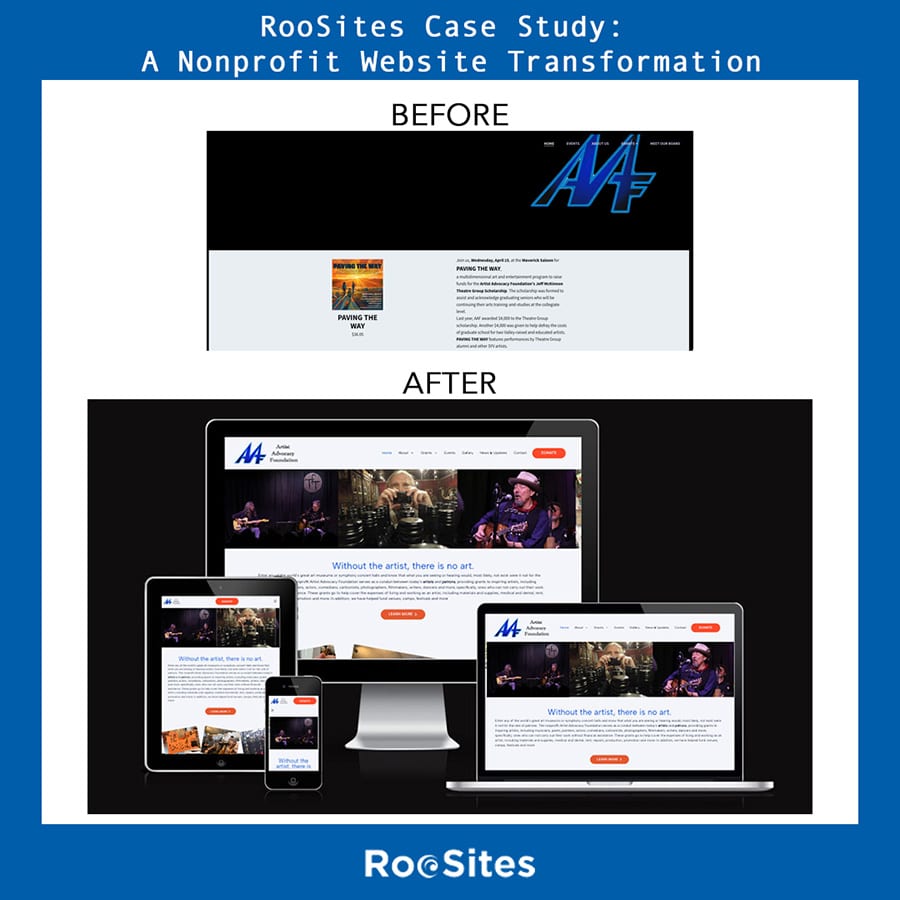
RooSites partnered with the Artist Advocacy Foundation to redesign and rebuild its website into a modern, user-friendly digital platform. The goal was to create a site that better reflected the foundation’s mission while making it easier for visitors to learn about the organization, explore events, review grant opportunities, and support the cause.
Before the redesign, the website had a dated appearance and lacked the polished presentation needed to reflect the importance of the organization’s work. The site offered limited visual impact, and key content was not presented in a way that made engagement easy for visitors.
Like many older websites, it faced challenges with usability, content organization, and overall appeal. Important information about events, grants, and the foundation’s mission needed to be more accessible and more compelling for users across all devices.
RooSites created a fully updated website designed to present the Artist Advocacy Foundation in a more professional, engaging, and modern way. The new website was built to highlight the foundation’s work while creating clear pathways for visitors to take action.
The updated site features a cleaner layout, stronger branding, improved navigation, and a responsive design that works smoothly on desktops, tablets, and mobile devices. RooSites also organized the content more effectively so visitors can quickly find information about the foundation, upcoming events, grants, galleries, news, and ways to donate.
The transformation resulted in a far more engaging and effective online presence for the Artist Advocacy Foundation. The new website gives the organization a polished platform that better supports outreach, storytelling, fundraising, and event promotion.
Visitors can now more easily understand the foundation’s purpose, explore opportunities, and engage with the organization. The updated design also creates a stronger first impression and better reflects the professionalism and passion behind the foundation’s mission.
For nonprofit organizations, a website plays a critical role in building awareness, encouraging donations, promoting events, and connecting with the community. A dated or difficult-to-use site can limit those opportunities. By redesigning the Artist Advocacy Foundation website, RooSites helped turn an outdated digital presence into a more powerful tool for engagement and growth.
This project is a strong example of how RooSites can transform an underperforming website into a modern, user-friendly digital experience. The new Artist Advocacy Foundation website is now better equipped to support artists, connect with supporters, and expand the organization’s reach.
If your current website no longer reflects your brand or is not generating the results you need, RooSites can help you create a better online presence built for today’s users. Contact us today!.
