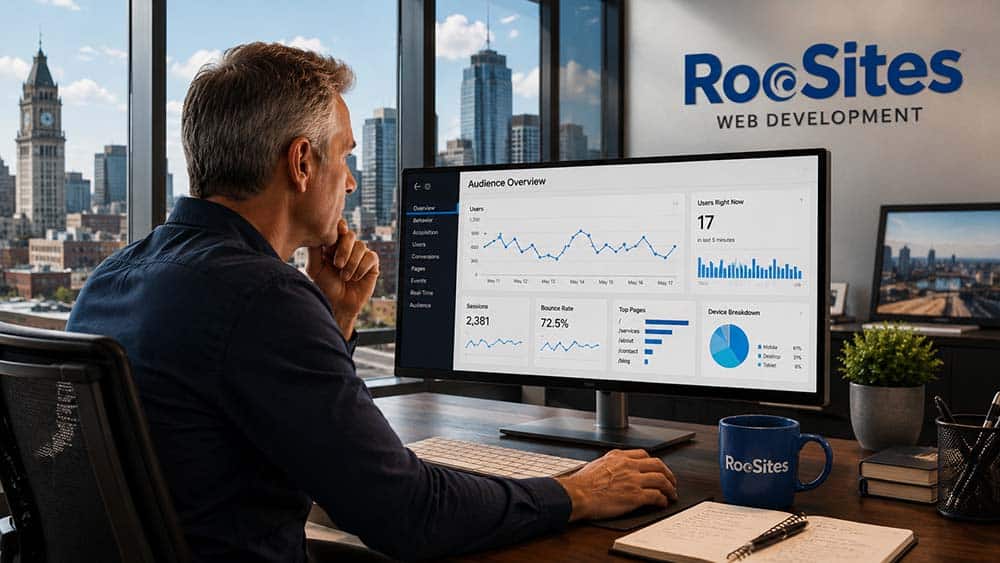
At RooSites Web Development, we’ve reviewed hundreds of websites for businesses throughout Boston and Massachusetts. One pattern appears again and again: businesses are losing customers before they ever have a chance to start a conversation.
Here are some of the most common reasons why.
Research consistently shows that visitors form an opinion about a website within just a few seconds.
If your site appears outdated, cluttered, or difficult to navigate, many visitors assume the business itself is outdated.
Trust-building elements include:
Your website should immediately answer one question: “Why should I trust this business?”
Speed matters.
A website that takes several seconds to load often loses visitors before they even see your content.
Slow websites also tend to rank lower in Google search results, creating a double disadvantage.
Improving website performance includes:
Every second counts.
Most local searches now happen on smartphones.
Whether someone searches for:
…they expect a fast, mobile-friendly experience.
If visitors need to zoom, scroll sideways, or struggle to click buttons, they’ll often move on to another company.
Many websites overwhelm visitors with too much information.
Instead, your navigation should make it easy to find:
Simple websites often convert better than complicated ones.
Many websites explain what they do—but never clearly tell visitors what to do next.
Every important page should include clear calls-to-action like:
Don’t make visitors guess.
Nothing hurts credibility faster than outdated content.
Examples include:
An actively maintained website sends a powerful message that your business is active and engaged.
People searching for local businesses want reassurance that they’re dealing with someone nearby.
Your website should clearly highlight:
Strong local signals help both customers and search engines.
Today’s consumers trust other customers.
Include:
Social proof reduces hesitation and builds confidence.
A website isn’t something you build once and forget.
Successful websites receive ongoing attention through:
Regular website management keeps your site performing at its best while helping it remain competitive in search results.
The hardest part is that you’ll never know how many customers leave your website without contacting you.
They simply click the back button and visit another business.
A professional website should work as your best salesperson—building trust, answering questions, and encouraging visitors to take the next step.
Your website often creates the first impression of your business. If it loads quickly, looks professional, provides helpful information, and makes it easy for visitors to contact you, you’re far more likely to earn their business.
At RooSites Web Development, we specialize in Boston Web Design, website development, SEO, hosting, and ongoing website management. We believe a successful website is never truly finished. It should continually evolve to meet customer expectations, support your marketing goals, and strengthen your online presence.
If your website isn’t generating the leads you expect, now is the perfect time for a fresh evaluation.
Contact RooSites today for a complimentary website review and discover how small improvements can lead to more visitors, more inquiries, and more customers.

Building a new website is an exciting step for any business. It is your digital storefront, your marketing hub, and often the first impression customers get of your brand. While most companies think about design, features, and content, there are several important factors that can be overlooked. Here are key things to consider when planning your new website, including a few you may not have thought of.
Your company will evolve over time, and your website should be able to grow with you. Choose a platform and hosting solution that can easily accommodate new content, features, pages, and increased traffic without slowing down or becoming unstable. Think about where your business will be in two to five years, not just today.
Responsive design is essential. A mobile-friendly website ensures a seamless experience whether users visit on a smartphone, tablet, or desktop. Do not just test layouts. Actually try filling out forms, clicking links, and navigating menus on different devices and browsers to make sure everything works smoothly.
A slow website costs you visitors and potential customers. Optimizing images, choosing quality hosting, minimizing unnecessary scripts, and leveraging caching can dramatically improve your site’s speed. Faster load times not only create a better user experience but also support your search engine rankings.
Making your website accessible is both the right thing to do and, in many places, a legal requirement. Use proper alt text on images, readable fonts, clear headings, sufficient color contrast, and keyboard navigation support to align with accessibility guidelines such as WCAG. This helps all users, not just those with disabilities.
Will you or your team need to update content regularly? Make sure your content management system (CMS) is user-friendly. If the backend is confusing or clunky, updates may get delayed, and your website can quickly become outdated. Request a brief training session or documentation from your developer.
Security should never be an afterthought. Ensure SSL is installed, set up firewalls, and keep all software and plugins updated. Use strong passwords and consider two-factor authentication where possible. Even small, low-traffic sites can be targets for automated attacks, so proactive protection is essential.
SEO is more than just keywords. It includes site structure, clean code, metadata, headings, internal links, and logical URLs. Work with a developer who understands SEO best practices or bring in a specialist early in the project. Fixing SEO issues after the site is built is usually more difficult and more expensive.
Privacy policies, terms of service, and cookie notices are often treated as an afterthought, but they may be legally required depending on your audience, location, and the tools you use. If you run ads, collect leads, or track analytics, make sure your policies are clear, accurate, and easy to find.
Install analytics tools as part of your initial launch plan. Tracking user behavior from day one helps you understand what is working and where people drop off. Over time, this data allows you to refine pages, improve conversion rates, and make smarter marketing decisions.
Things go wrong: updates break layouts, plugins conflict, or a mistake deletes important content. Make sure your hosting or website platform automatically backs up your site and that you know how to restore it if needed. A solid backup and recovery plan can turn a potential disaster into a minor inconvenience.
Confirm that your business owns the domain name, hosting accounts, and website content. Ensure you have administrative access to your CMS, hosting panel, domain registrar, and analytics tools. You never want to be in a position where a former developer or agency holds the keys to your online presence.
Building a website is more than just uploading a few pages and hitting publish. It is a strategic effort tied to user experience, branding, marketing, and long-term growth. By considering scalability, security, accessibility, analytics, and ownership from the start, you can launch a website that works harder for your business and avoids costly surprises down the road. And if you need help designing, developing, and managing that website, RooSites is here for you, Contact Us Today!
