Pages load. Contact forms work. Customers find your phone number. Orders come through. Emails arrive. Everything seems fine.
But behind the scenes, a business website requires ongoing attention. There are dozens of small tasks that help keep a website secure, functional, fast, and effective-and unfortunately, many businesses don’t think about those tasks until something goes wrong.
At RooSites, we believe a website is never truly “done.” Launching a website is only the beginning. The real work is keeping it working for your business every day.
Here are some of the website tasks that are easy to overlook-until they suddenly become very important.
WordPress websites typically rely on WordPress core, a theme, and multiple plugins working together.
Those components are constantly being updated for security, compatibility, bug fixes, and new features.
Ignoring updates can leave your website vulnerable to security issues or create compatibility problems when your hosting environment changes.
But blindly clicking “Update All” isn’t necessarily the answer either. Updates should be managed carefully so that problems can be identified and corrected quickly.
Most website owners know they should have backups.
But there’s another question that’s just as important:
Can the website actually be restored from them?
A backup system isn’t very useful if backups have stopped running, files are incomplete, the database isn’t included, or nobody knows how to restore the website when it’s needed.
Backups should be automated, monitored, and periodically verified.
Your contact page looks fine. The form displays correctly. The confirmation message says, “Thank you for contacting us.”
But did the email actually arrive?
Website forms can stop delivering email for many reasons, including server changes, spam filtering, authentication problems, plugin conflicts, and email configuration issues.
The scary part is that there may be no obvious sign anything is wrong. A business could potentially miss inquiries for days or weeks before someone realizes the form isn’t working.
That’s why forms should be tested regularly-not just when the website launches.
Form functionality and email delivery aren’t necessarily the same thing.
Your website may successfully process a form submission while the resulting notification gets rejected, filtered into spam, or never reaches the intended inbox.
Proper SMTP configuration and email authentication can help improve reliability, but these systems also need monitoring.
If your website generates leads, orders, registrations, or important notifications, email delivery isn’t a minor technical detail. It’s part of your business operation.
Visitors expect to see that little padlock in their browser.
An expired or improperly configured SSL certificate can result in alarming security warnings and immediately damage trust.
Even when certificates renew automatically, renewal failures and configuration problems can happen. SSL should be monitored rather than assumed.
Website security isn’t simply installing a security plugin and forgetting about it.
Websites are constantly hit by automated bots looking for vulnerable plugins, weak passwords, outdated software, exposed login pages, and other opportunities.
Ongoing security management can include monitoring suspicious activity, blocking malicious traffic, reviewing alerts, updating vulnerable software, and responding quickly when something unusual occurs.
The best security problem is the one that’s addressed before the website owner ever knows it existed.
Websites rarely become slow overnight. Performance often deteriorates gradually.
Images get uploaded without optimization. Plugins accumulate. Databases grow. Third-party scripts are added. Hosting environments change.
Eventually someone says, “Has the website always been this slow?”
Regular performance checks can identify these issues before they significantly affect visitors.
A website can look perfect on a desktop computer and have problems on a phone.
Buttons can become difficult to tap. Headlines can wrap strangely. Popups can cover important content. Forms can become frustrating to complete.
And because website administrators often work from desktop computers, mobile problems can go unnoticed.
Your website should be checked regularly on actual mobile devices and at different screen sizes.
Websites evolve. Pages are deleted. URLs change. Products disappear. Staff members leave. Outside websites reorganize their content.
Over time, links that once worked can lead visitors to 404 errors.
Broken links create a poor user experience and can also make a website feel neglected.
Periodic link checks and proper redirects help keep visitors moving in the right direction.
The technology running your website doesn’t stand still.
Hosting companies upgrade PHP versions, server software changes, and older themes or plugins can eventually become incompatible with modern hosting environments.
A website may work perfectly for years and suddenly develop errors after a server upgrade.
Keeping an eye on compatibility helps prevent an aging piece of software from becoming an emergency.
Is website traffic increasing or decreasing? Which pages are attracting visitors? Are important pages disappearing from search results? Are visitors reaching the pages you actually want them to see?
Analytics and search data can reveal problems long before someone notices them manually.
A sudden traffic decline, indexing problem, or disappearing search ranking deserves investigation.
Not every website problem is technical.
Sometimes the website works perfectly, but the information is old.
Maybe your services have changed. Your staff has changed. Your hours are different. You serve new locations. Your photos are outdated. Or a page still promotes something you stopped offering two years ago.
A technically flawless website with outdated information can still cost you business.
A completely broken website gets attention immediately.
A partially broken website can be much more dangerous.
One form stops sending email. One important page disappears from Google. One plugin develops a vulnerability. One mobile button stops working. One outdated service page gives potential customers incorrect information.
Everything else appears normal, so nobody notices.
That’s why proactive website management matters.
When a website is properly managed, many problems are discovered and corrected before they become emergencies.
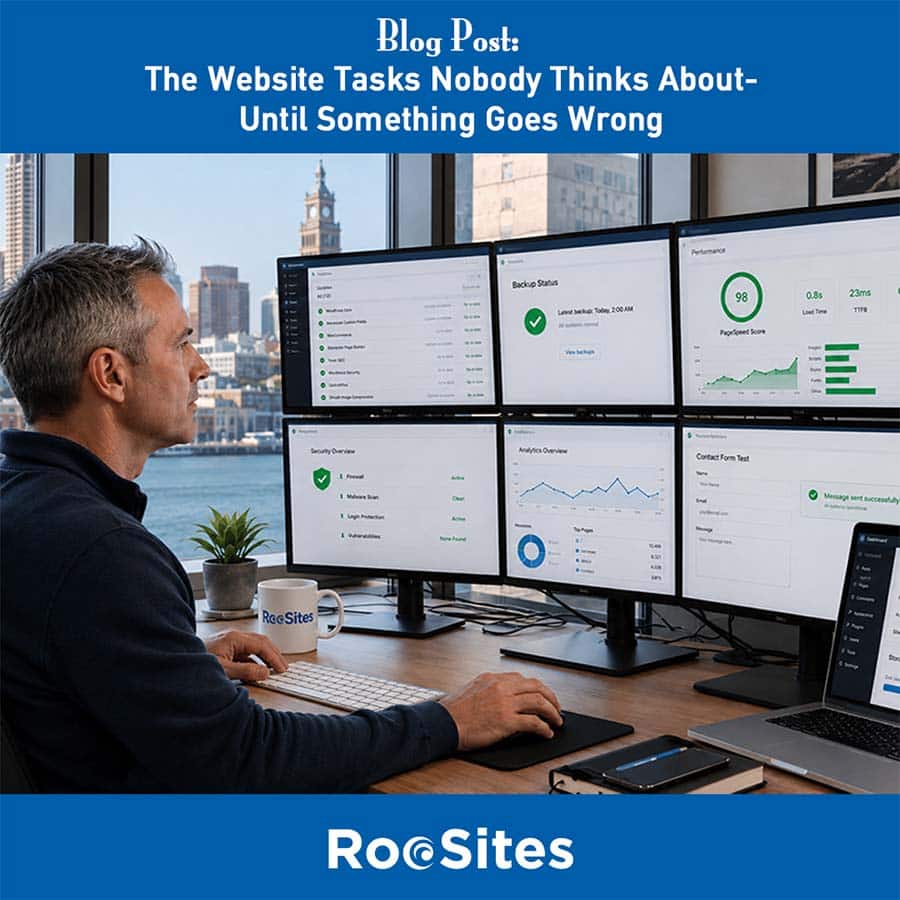
Updates happen. Backups run. Forms are tested. Security is monitored. Performance is checked. Content evolves. Problems are investigated.
And the business owner gets to concentrate on running the business rather than worrying about the website.
That’s the philosophy behind RooSites.
Your website isn’t a project you finish. It’s an important business asset you manage.
If your website only gets attention when something breaks, it’s time for a different approach.
RooSites Web Development provides professional website design, development, hosting, maintenance, security, content updates, and ongoing website management for businesses throughout the United States. Contact RooSites to learn how we can keep your website working, secure, current, and effective.

Our team has been entrusted with the design, development, and ongoing management of two new websites that will help these organizations better connect with the people they serve while providing a modern, secure, and user-friendly online experience.
Every project we undertake is built with long-term success in mind-from responsive design and search engine optimization to website security, performance, and ongoing management. We believe a website should continue to evolve long after launch.
We appreciate the opportunity to partner with these outstanding organizations and look forward to sharing their new websites in the coming months.
Thank you to Integrative Wellness With Lauren and Access 2 Community and Friendship for placing your trust in RooSites. We’re excited to be part of your journey.
